04.06.2026 12:51
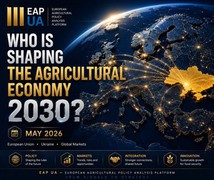
WHO IS SHAPING THE AGRICULTURAL ECONOMY OF 2030

04.06.2026 12:51
The developments of spring 2026 confirmed one of the central trends in global agricultural policy: leading economies increasingly view agriculture not only as a production sector, but also as a component of economic resilience, food security and strategic autonomy.
Global agricultural markets are entering a period in which competitiveness will be determined not only by production volumes or price, but also by the ability of states and companies to control supply chains, manage risks and ensure quality, traceability and export stability.
GLOBAL MARKET REALIGNMENT AND NEW COMPETITION
Global food trade is gradually becoming part of a broader strategic policy agenda. Major centres of influence are reassessing their approaches to food security and agricultural support.
· The United States: continues work on a new Farm Bill. In this process, farm support is increasingly linked to production modernisation, research, infrastructure, energy and the resilience of rural areas.
· China: is strengthening its food security policy, diversifying import sources and paying greater attention to agricultural technologies. For Beijing, food security is increasingly part of wider economic security, particularly amid trade tensions and climate risks.
· Brazil: is consolidating its position as one of the world’s key agricultural exporters. Its advantages remain scale of production, competitive costs and a strong presence in Asian, Middle Eastern and African markets.
· India: remains an important factor in food price volatility. Crop yields, monsoon risks and export restriction decisions can significantly affect global prices for rice, oilseeds and pulses.
THE EUROPEAN UNION’S ASYMMETRIC POLICY
The European Union is also revising its approach to the Common Agricultural Policy. Food security, farmers’ competitiveness, the cost of production inputs, environmental requirements and post-2027 budget constraints remain at the centre of the debate.
In practice, an asymmetric regulatory model is taking shape. For EU producers, the Union is gradually simplifying some administrative procedures and expanding the flexibility of member states in implementing agricultural policy. At the same time, market-access requirements for external suppliers remain high or are becoming stricter.
This concerns, above all, sanitary and phytosanitary requirements, pesticide residue controls, veterinary rules, certification, product safety and traceability. The European market is not closing, but access to it increasingly depends on an exporter’s ability to demonstrate compliance with EU standards.
NEW REQUIREMENTS FOR UKRAINE’S EUROPEAN INTEGRATION
For Ukraine’s agricultural sector, following the end of the phase of autonomous trade measures, the key issue is no longer only physical access to the EU market, but structural and institutional compatibility with European rules.
In the coming years, Ukraine’s competitiveness will depend on several strategic priorities.
Institutional alignment: Gradual implementation of the EU agricultural acquis and the introduction of management, control and monitoring systems required to operate within the logic of the Common Agricultural
- Policy. These include IACS, LPIS, FSDN and AKIS: instruments for administering support, identifying agricultural land, data collection and knowledge exchange in agriculture.
- Processing and added value: Reducing dependence on raw commodity exports. Under tariff-rate quotas, stronger competition and stricter regulatory requirements, better positions will be held by producers that develop processing, certification, long-term contracts and integration into European value chains.
- Digitalisation and traceability: Transparent product origin, control of production processes, laboratory verification and reliable data are becoming not an additional advantage, but a basic condition for access to regulated markets.
- Resource efficiency: High costs for energy, fertilisers, logistics and credit are pushing agricultural producers towards more precise cost management, energy-efficient solutions, precision farming and local models of energy autonomy.
CONCLUSION FOR UKRAINE
In the new system of global agricultural competition, Ukraine needs to preserve its production advantages, but this alone will no longer be sufficient. The next stage will require institutional maturity, compliance with standards, development of processing capacity and the ability to operate in a more demanding regulatory environment.
These are the factors that will define Ukraine’s place in the agricultural economy of the 2030s.
EAP UA (Pavlo Koval) | Republished by: UAC
- 1382 reads
News
20.10.2026 12:19
17.10.2026 22:10
09.10.2026 19:12
02.10.2026 23:51
29.09.2026 08:43
18.09.2026 10:33
10.09.2026 15:22
31.08.2026 12:45
17.08.2026 18:13
10.08.2026 13:13