02.10.2026 23:51
Ukraine Must Help Shape the Next CAP

02.10.2026 23:51
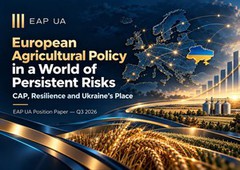
Ukraine’s agricultural integration into the European Union will depend on how both sides adapt to a changing Common Agricultural Policy (CAP). As Europe rethinks the financing of farm support and resilience, Ukraine needs a clear position on how its production capacity can contribute to a more secure European food system.
This is the central argument of the EAP UA position paper for the third quarter of 2026 by Pavlo Koval, Director General of the Ukrainian Agrarian Confederation. His analysis connects the debate on the CAP after 2027 with Ukraine’s wartime transformation and the growing interaction between climate, energy, trade and food security.
For agricultural businesses, these discussions have practical consequences. They will influence access to finance, the cost of meeting European standards, the reliability of export routes and the conditions under which Ukrainian producers eventually compete within the Single Market.
Who will finance agricultural resilienceThe policy debate is widening beyond the distribution of farm payments. Drought, water scarcity, animal disease, expensive fertilisers and disrupted trade can affect producers simultaneously. Koval argues that agricultural support must increasingly be judged by its ability to keep farms producing, investing and accessing markets through such shocks.
That requires a clearer division of responsibility between farmers, insurers, national governments and common European mechanisms. Insurance, irrigation, alternative logistics and emergency liquidity all have a cost. Leaving too much of that cost to individual producers can weaken investment precisely when adaptation is most needed.
The European Commission’s proposal for the 2028–2034 EU budget would integrate the CAP into National and Regional Partnership Plans alongside other policy priorities. Although the proposal includes protected funding for farm income and crisis support, the balance between common guarantees and national discretion remains central to the negotiations.
Greater flexibility can help countries respond to different farming structures and climates. The risk identified in the paper is that resilience could increasingly depend on the strength of national budgets. Farmers operating under common market rules might receive very different levels of protection against the same shock. For Ukraine, this makes credible EU-level risk sharing and fair competitive conditions particularly important.
Food security depends on the whole supply chainThe OECD–FAO Agricultural Outlook 2026–2035 projects global agricultural production growth of around 13% over the coming decade, driven mainly by productivity improvements and intensification. That baseline does not remove the danger of supply disruptions. Production potential depends on access to inputs, investment and functioning trade.
The paper explains how disruption can move through the system. Interrupted energy supplies raise fertiliser costs; reduced fertiliser use can lower subsequent harvests. Insecure shipping routes increase freight and insurance costs, while simultaneous weather shocks can reduce the ability of other producing regions to compensate. Storage, processing and household purchasing power also determine whether available food remains affordable.
Koval describes the emerging response as managed interdependence: maintaining open trade while reducing excessive reliance on individual suppliers, inputs or transport routes. Diversification, strategic reserves and sufficient domestic capacity can make the system more reliable. Their value must be assessed against the losses caused when a critical supply route fails.
Ukraine needs economically viable export routesUkraine’s wartime experience shows how quickly logistics problems become production problems. A route can remain physically available while becoming too expensive for farmers to use profitably. Lower prices at the farm gate and delayed export receipts then reduce the funds available for the next sowing campaign.
At the Agriculture and Fisheries Council on 28 September, Ukraine’s agriculture minister warned that, if port restrictions persisted, more than 30 million tonnes of agricultural products could remain unexported by the end of the season. Potential losses in producer income could exceed US$10 billion. These were conditional government estimates of the risk, rather than losses already incurred.
Ukraine asked the EU to consider temporary partial compensation for extraordinary logistics costs. The broader policy question raised by Koval is how the cost of maintaining Ukrainian food exports should be shared when those exports contribute to European and global food security.
Alternative routes, maritime insurance and credit guarantees therefore need to be considered together. Emergency liquidity can keep farms operating, but durable resilience also requires reliable transport and predictable market access. Wartime measures should provide a foundation for long-term modernisation, including demining, irrigation and investment in production.
EU accession will require adaptation on both sidesUkraine must strengthen the institutions needed to administer agricultural support and enforce European standards. The designation of the Ukrainian State Fund for Support of Farms to perform Paying Agency functions took effect on 1 July 2026. The government’s announcement also made clear that further regulatory and institutional preparation was required.
The practical priorities include a capable Paying Agency, the Integrated Administration and Control System (IACS), reliable data in the State Agrarian Register and effective traceability and financial controls. These systems must support sound policy decisions and accountable payments. Their effectiveness will depend on staff, interoperable registers and functioning administrative procedures.
At the same time, Ukraine’s scale means that accession will affect the EU’s own agricultural policy. Its land base and output raise questions about the distribution of support, competition in sensitive sectors and the sustainability of existing funding models. Future CAP payments and transitional arrangements remain matters for negotiation.
Koval’s argument is that this discussion must also recognise the contribution Ukraine could make through grain and oilseed production, feed supplies, processing and investment opportunities. Integration should balance competitive and budgetary pressures with the benefits of a larger European production base. Ukraine’s institutions must be capable of working within a CAP that continues to evolve.
Competitiveness must support the environmental transitionFor Ukrainian producers, regulatory alignment carries immediate costs while full participation in CAP support lies ahead. Koval warns that adopting European requirements without investment in technology could deliver formal compliance at the expense of competitiveness.
Precision farming, efficient water and nutrient use, automation and better agricultural data can help reconcile environmental objectives with farm viability. In Ukraine, these investments also address structural labour shortages. Their value should be measured by whether they improve productivity, reduce resource pressure and help businesses manage risk.
The same economic discipline applies to processing. Higher-value products can retain more income domestically and absorb higher transport costs, but policy must take account of the grain sector’s continued importance. Modernisation requires investment and a workable transition across the agricultural economy.
Four possible paths for European agricultureThe EAP UA paper sets out four scenarios around two uncertainties: how much responsibility remains at EU level, and how strongly security concerns reshape trade and agricultural support. These are analytical possibilities, not forecasts or agreed policy outcomes.
Managed European Interdependence. A strong common CAP would coexist with open trade, diversification and clear safeguards. Ukraine’s integration would proceed mainly through shared European rules and phased arrangements.
European Agri-Food Security. The EU would strengthen collective investment in risk sharing, critical inputs, infrastructure and productive capacity. Ukraine could become a more significant partner in securing food supplies, alongside demanding requirements for governance, traceability and safety.
Competitive Decentralisation. More responsibility would pass to national governments. Differences in their ability to finance insurance, technology and crisis support could weaken equal competition and complicate Ukraine’s integration.
Fragmented Autonomy. Persistent shocks, combined with weak common financing, would encourage separate national protection strategies. Ukrainian exports and accession terms could face increasingly fragmented political restrictions.
Across all four scenarios, Ukraine would need stronger institutions, better risk management and sustained technological investment. What changes is the European system within which those capabilities would operate.
A practical agenda for UkraineThe paper’s recommendations point towards a connected programme of reform. Ukraine should turn emergency financial tools into more durable arrangements for insurance and investment, diversify export logistics and improve water resilience. Agricultural data, traceability and support administration need to become dependable services for producers and public authorities.
These domestic measures should be accompanied by a clear position in discussions with the EU on transitional arrangements, safeguards, support financing and the contribution of Ukrainian agriculture to shared food security. The terms of integration will shape both the costs borne by producers and the opportunities available to them.
The next negotiating milestones will help clarify the direction of reform. Following the September Council discussion, the Irish presidency aims to secure a partial Council position on the post-2027 CAP at the meeting on 26–27 October. The wider 2028–2034 budget negotiations will remain decisive for funding and the division of responsibilities.
For Ukraine, progress should be measured by its ability to keep farms viable through shocks while preparing them to operate within the Single Market. In Koval’s assessment, that requires Ukraine to formulate its own vision for the next CAP and demonstrate how its agricultural potential can strengthen European competitiveness and food security.
EAP UA (Pavlo Koval) | Republished by: UAC
- 9 reads
News
02.10.2026 23:51
29.09.2026 08:43
18.09.2026 10:33
10.09.2026 15:22
31.08.2026 12:45
17.08.2026 18:13
10.08.2026 13:13
09.08.2026 15:55
05.08.2026 11:00