24.03.2026 09:28
“The domestic market will be fully supplied with food despite fertilizer shortages and a challenging sowing campaign” – interview with Leonid Kozachenko

24.03.2026 09:28
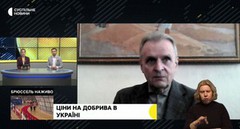
The President of the Ukrainian Agrarian Confederation, Leonid Kozachenko, in an interview with Suspilne News, analyzed the current situation on the mineral fertilizers market, outlined the impact of European sanctions against Russia on the agricultural sector, and shared his outlook on the upcoming harvest and food prices in Ukraine.
To better understand the overall situation, could you explain where the European Union currently sources fertilizers from and how dependent it is on Russia?
Leonid Kozachenko: Before the full-scale war, the EU imported nearly one-third of its fertilizers from Russia and Belarus. The rest came from Egypt, Morocco, Turkmenistan, and Azerbaijan. So, the dependency was significant. However, imports from aggressor countries have now halved. Last year, the EU introduced a duty of €45 per tonne on Russian and Belarusian fertilizers and plans to increase it annually. By July this year, this figure is expected to double. As a result, import volumes are rapidly declining.
A complete halt of trade with Russia and Belarus will not be catastrophic for European farmers, as there are alternative sources — North Africa, for instance, particularly Egypt, which produces large volumes of fertilizers.
The UCAB has appealed to the government to abolish duties on nitrogen fertilizer imports until the end of 2026 to support farmers during the sowing campaign. Is the government ready for such steps, and will it help?
Leonid Kozachenko: This is a very important but complex issue. The main problem is that ammonium nitrate with a high nitrogen content is explosive. In wartime conditions, this creates serious risks. However, there are other types of nitrate.
The government needs to carefully refine the regulatory framework and allow imports of those nitrate types whose chemical composition does not pose explosive risks. A total ban on nitrate imports would be the wrong decision and would harm our agricultural sector.
How will rising fertilizer prices and shortages affect food prices in Ukraine and Europe?
Leonid Kozachenko: In Europe, farmers buy expensive fertilizers, but the EU heavily subsidizes its agricultural sector, compensating for these additional costs. Therefore, significant price spikes may not occur there.
In Ukraine, the situation is more complicated. We are simply forced to apply less fertilizer. It is worth noting that even before the war, Ukraine used significantly less fertilizer than Western countries. For example, we applied about 25 kg of active substances per hectare, compared to 125 kg in the EU and 140 kg in the United States. Our main competitive advantage has always been and remains the quality of our soils — chernozems with a high humus content.
What are your forecasts for this year’s harvest? Should Ukrainians be concerned about food shortages?
Leonid Kozachenko: Due to the current shortage, we may lose around 8 million tonnes of harvest compared to last year. However, I want to reassure everyone: this will not create problems for the country’s food security. The domestic market will be fully supplied — 100%. There will be no need to import staple grains.
There may be a certain shortage of high-quality food-grade wheat (second and third class), as reduced fertilizer application will increase the share of feed-grade (fourth class) grain. Only in this segment might targeted imports occur.
As for food prices, they may increase, but by no more than 15%. This growth will depend not only on fertilizer costs but also on fuel shortages and the lack of affordable working capital for farmers, as borrowing at 20% interest rates places a heavy burden on agricultural profitability. However, there will be no catastrophe — Ukraine will have bread.
IC UAC according to Suspilne News
- 671 reads
News
20.10.2026 12:19
17.10.2026 22:10
09.10.2026 19:12
02.10.2026 23:51
29.09.2026 08:43
18.09.2026 10:33
10.09.2026 15:22
31.08.2026 12:45
17.08.2026 18:13
10.08.2026 13:13