Made by ElVisti
© Ukrainian Agrarian Confederation, 2006-2026.
All rights reserved.
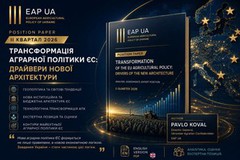
The European Union’s Common Agricultural Policy is entering a period of structural change. It is no longer only about farm income, market regulation or rural development. The emerging CAP is becoming part of a broader European agenda: food security, strategic autonomy, technological competitiveness, resource efficiency and economic resilience.
The second quarter of 2026 made this shift especially visible. Processes that had previously developed in parallel — the debate on the post-2027 CAP, the new Multiannual Financial Framework, trade policy, fertiliser security, artificial intelligence, biotechnology, water resilience and Ukraine’s accession process — began to form a single policy picture. The EU is not simply adjusting its agricultural policy. It is redefining the role of agriculture in Europe’s future economic and security architecture.
Geopolitics has changed the status of agricultureThe first major driver is geopolitical. Russia’s war against Ukraine, instability in energy and fertiliser markets, risks to maritime logistics and pressure on food supply chains have changed the way Europe understands agriculture. Food security is no longer seen only as the availability of food on the market. It is increasingly understood as the capacity to preserve production, protect logistics, secure inputs and keep agri-food systems functioning under long-term instability.
This is particularly important for Ukraine. Ukrainian agriculture has already become part of Europe’s food security architecture before Ukraine has formally joined the EU. The Solidarity Lanes, the role of Ukrainian grain exports and the direct connection between Ukraine’s production capacity and global food security have changed the political status of Ukraine’s agricultural sector. Ukraine is no longer only a future candidate adapting to EU rules. It is already one of the factors shaping the EU’s agricultural debate.
Resource security is becoming a core agricultural issueThe second major change concerns production inputs. Fertilisers, energy, water, logistics and transport corridors are no longer treated as ordinary market factors. They are becoming strategic assets.
Volatile fertiliser prices and concerns over supply chains have shown that agricultural competitiveness cannot be separated from resource security. If farmers do not have predictable access to fertilisers, affordable energy and reliable logistics, public support alone cannot preserve production capacity. This is why fertiliser policy, water resilience and energy costs are moving closer to the centre of the CAP debate.
For Ukraine, the signal is direct: future competitiveness will depend not only on land, scale and export potential, but also on the ability to manage inputs efficiently, reduce production risks and build more resilient logistics and energy systems.
The future CAP will be less autonomous and more competitiveThe institutional architecture of the CAP is also changing. The debate on the EU’s 2028–2034 budget shows that agricultural policy will increasingly be placed within a wider system of European public investment.
Agriculture will have to coexist with defence, industrial policy, digital transformation, innovation, support for Ukraine and strategic competitiveness.
This does not mean that farm support will disappear. The European Commission still proposes to protect a large envelope for farmers’ income support. However, the meaning of support is changing. It is no longer only compensation for income losses or market volatility. It is becoming an instrument for investment, modernisation, risk management, generational renewal and technological adaptation.
This is a major shift. The CAP is moving from a policy that mainly stabilised agriculture to a policy that is expected to transform it.
Trade policy is moving towards managed opennessThe EU’s external trade model is also evolving. The EU–Mercosur agreement and the development of safeguard mechanisms show that Europe is not abandoning market openness, but it is no longer treating liberalisation as a purely economic process. Market access is now being combined with monitoring, safeguards and rapid-response instruments.
This model is highly relevant for Ukraine. Ukrainian agricultural exports will enter a European market that is becoming more open, but also more carefully managed. Future integration will not be only about access to the Single Market. It will also require the ability to operate within a system of permanent risk assessment, market monitoring and safeguard mechanisms.
Competitiveness now depends on technology, data and innovationThe third driver is technological. European agricultural competitiveness is no longer measured only by production volumes, costs or direct support. Increasingly, it depends on digitalisation, artificial intelligence, precision farming, biotechnology, robotics, renewable energy, soil monitoring, water efficiency and the bioeconomy.
This is one of the most important conclusions of the report. The EU is moving from a model in which agriculture is supported mainly through payments to a model in which competitiveness depends on the capacity to use resources more intelligently. Data, algorithms, AI-assisted decision-making, autonomous machinery and new genomic techniques are becoming part of the future production model.
In practical terms, the farmer of the future will compete not only through access to land or subsidies, but through the quality of management: how efficiently fertilisers are used, how water is saved, how soil health is monitored, how production data are processed and how quickly technologies are integrated into daily farm operations.
Ukraine is preparing for a moving targetFor Ukraine, the key challenge is that accession negotiations are taking place while the CAP itself is being redesigned. Ukraine is not preparing to join a stable policy framework. It is preparing to join a policy that is moving towards a new model of resilience, competitiveness and technological transformation.
This changes the meaning of European integration for Ukrainian agriculture. Legal approximation remains necessary, but it is not enough. Ukraine will also need stronger institutions, digital governance, risk management systems, innovation capacity, modern advisory services, transparent data systems and investment in technological modernisation.
At the same time, Ukraine should not see itself only as a future recipient of CAP rules. Its scale, production capacity, black soils, export role, wartime resilience and rapidly developing AgTech potential make Ukraine a strategic factor in the future of European agriculture. After accession, Ukraine could strengthen the EU’s food security, bioeconomy, renewable energy potential and global agricultural competitiveness.
The main conclusionThe CAP is becoming more than an agricultural support policy. It is turning into one of the EU’s instruments for managing security, competitiveness, resources and technological change.
For Ukraine, this creates both a challenge and an opportunity. The challenge is that formal harmonisation with EU rules will not be sufficient. The opportunity is that Ukraine can enter the EU not only as a large agricultural producer, but as a country capable of strengthening Europe’s food security, resource base and technological transformation.
The future of European agriculture will be shaped not only by how much food is produced, but by how resilient, efficient and technologically advanced the production system becomes. Ukraine’s place in this future will depend on whether it can adapt not only to the current CAP, but to the new CAP architecture that is already emerging.
The full Position Paper Report is attached
EAP UA (Pavlo Koval) [2] | Republished by: UAC
| Attachment | Size |
|---|---|
| position_paper_q2_en.pdf [3] | 668.6 KB |
© Ukrainian Agrarian Confederation, 2006-2026.
All rights reserved.
Links:
[1] https://agroconf.org/en/category/news-rubrics/news/uac-news
[2] https://www.facebook.com/share/p/1LUwvex82m/
[3] https://agroconf.org/sites/default/files/position_paper_q2_en.pdf