Made by ElVisti
© Ukrainian Agrarian Confederation, 2006-2026.
All rights reserved.
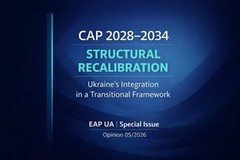
Opinion 05/2026 published by the European Court of Auditors (ECA) does not amend current legislation and does not redefine the Common Agricultural Policy (CAP). However, its substance signals a moment of structural tension in the proposed CAP architecture for the 2028-2034 period. The ECA warns that the proposed model may result in a complex CAP legal architecture and complicated planning arrangements, potentially affecting predictability, implementation timelines, and certainty for beneficiaries. The European Union is transitioning from a predominantly rules-based and ring-fenced agricultural policy toward a more adaptive, performance-oriented, and integrated budgetary framework. For Ukraine, the strategic implication is clear: accession negotiations on Chapter 11 will take place while the CAP itself is undergoing a structural transformation.
The End of the Standalone Agricultural Fund
The proposed CAP 2028-2034 framework is embedded within the broader Multiannual Financial Framework (MFF) reform. For the first time since 1962, the CAP would no longer operate through a standalone agricultural fund but as part of a unified financial instrument implemented via National and Regional Partnership Plans. This represents a fundamental budgetary redesign rather than a mere administrative adjustment. Several structural drivers converge to force this change, including sustained fiscal pressure on the EU budget, the need for stronger coordination between agricultural, cohesion, and security policies, political pressure within the farming sector, and the strategic context of EU enlargement. The ECA's intervention reflects concerns that integrating the CAP into a broader fund may increase administrative and legal complexity, thereby affecting implementation efficiency.
Flexibility Versus Common Rules
Historically, the European added value of the CAP has been grounded in ensuring fair competition across Member States, maintaining consistent internal market rules, providing a common framework of support, and strengthening food security in times of crisis. The proposed reform expands Member State discretion through national programming. The ECA cautions that excessive differentiation could weaken the common elements of the policy and generate uneven playing field conditions. Increased flexibility for Member States should not undermine the common character of the CAP nor create uneven competitive conditions within the internal market. The central policy question becomes whether the European Commission will be able to exercise a sufficiently strong steering role to safeguard coherence. If coordination mechanisms prove insufficient, the CAP risks evolving into a formally common but substantively differentiated system.
Financial Architecture and Governance
The proposal retains a ring-fenced envelope for income support while integrating other interventions into a broader fund structure involving national co-financing. The ECA highlights uncertainty regarding the final volume of CAP expenditure, which will depend on the approval of national plans. This implies a shift from fixed and predictable allocations toward conditional and program-dependent financial outcomes. For the EU, this may increase divergence depending on Member States' fiscal capacity. The new delivery model increases the emphasis on performance indicators and milestone-based financing. The ECA stresses that regardless of the chosen approach, accountability and traceability must be ensured from EU accounts to final beneficiaries. This requirement elevates administrative capacity to a strategic priority.
Strategic Implications for Ukraine
Ukraine's accession dialogue on Chapter 11 will unfold during this period of CAP reconfiguration. Negotiations will extend beyond sectoral standards to include institutional governance and financial architecture. Alignment must include readiness for performance-based management.
Future integration into the CAP will not be solely about regulatory alignment; it will require credible medium-term fiscal planning and co-financing capacity. Integration will require fully operational beneficiary registers, digital traceability systems, alignment with EU audit standards, and robust monitoring infrastructure. Without these institutional foundations, financial integration would be severely constrained. Discussions regarding a level playing field will occur in a context where internal differentiation within the EU is itself under pressure. At the same time, food security — identified by the ECA as a core EU-wide challenge — provides a structural argument for Ukraine's integration as a stabilising actor within the European agri-food system.
Conclusion
Opinion 05/2026 does not signal a crisis; it marks a structural recalibration. The EU is attempting to reconcile simplification, flexibility, and fiscal discipline while preserving the common character of the CAP. The key question is not whether the CAP will change, as it already is changing. The decisive question is whether the EU can maintain policy coherence under a more adaptive budgetary model and whether Ukraine can align with a system that is itself in transition.
EAP UA (Pavlo Koval) [2]| Republished by: UAC
© Ukrainian Agrarian Confederation, 2006-2026.
All rights reserved.
Links:
[1] https://agroconf.org/en/category/news-rubrics/news/uac-news
[2] https://www.facebook.com/share/p/1Ma4M7eNgE/